
Tracking and repairing broken links across websites exposes revenue risk and slows down campaign management for creators, agencies, and marketing teams. Many tools demand manual fixes, restrict advanced features to paid plans, or lack integration with payment and commerce data sources. This comparison outlines how the top three alternatives differ on automation, reporting, and integration so you can see which one fits your workflow.
Table of Contents
Operaliq
At a Glance
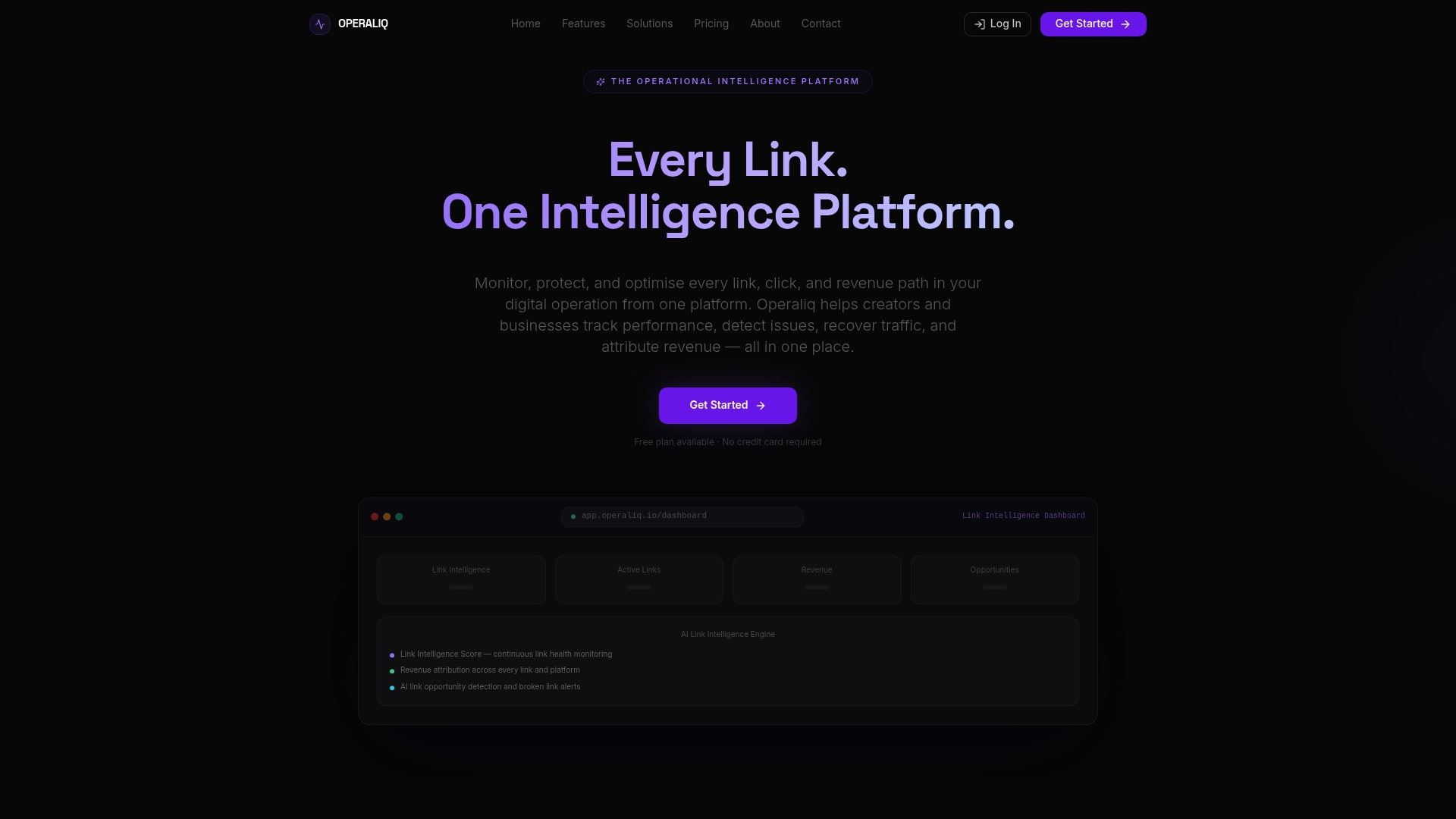
Automated recovery for broken links uses backup destinations and Shield technology to keep traffic flowing and revenue intact. Operaliq combines continuous link health monitoring with real-time alerts and revenue attribution. The platform also delivers AI recommendations and a mobile dashboard for on-the-go monitoring.
Core Features
Operaliq runs continuous link health monitoring with real-time alerts and automated broken link detection, so you spot failures before visitors do. It captures revenue attribution across channels and links and surfaces AI-powered opportunity detection and growth recommendations. The product also offers Smart Links, backup destinations, role-based team management and marketplace integrations for commerce and social platforms.
Key Differentiator
The single biggest advantage is the pairing of live event data with protection and AI suggestions in one operational dashboard. That mix lets creators and businesses link revenue directly to destination behaviour and recovery actions. The dependency on connected data sources means the value grows as you add Stripe, Shopify and analytics integrations.
Pros
Connected platform data produces metrics you can trust because events come from payments, stores and social platforms rather than sampled crawls. Built-in protection features prevent lost revenue by automatically redirecting broken links to backup destinations. AI insights point out specific opportunities to adjust links and campaigns, and a mobile dashboard keeps monitoring available away from a desk. Flexible plans include a free tier for simple use and paid plans for higher volume and team features.
Cons
- Requires connected platforms for accurate data and insights. Proper setup and integrations are needed for the platform to deliver its predictions and recovery actions.
Notable Integrations
Operaliq connects payment and commerce systems, social channels and analytics platforms to feed event and revenue data. Integrations include Stripe, Shopify, TikTok, Instagram, Facebook, YouTube, LinkedIn and X (Twitter). These connections let the dashboard attribute income and trigger automated recovery rules.
Who It's For
Creators, influencers and online businesses that link multiple revenue sources will benefit most. Marketing teams that run campaign links across social platforms will gain clearer attribution and faster recovery. It is less suited to offline stores that lack connected digital event streams.
Unique Value Proposition
Smart Links with backup destinations and Shield technology act as an automatic safety net for revenue-bearing links. That reduces manual checks and the revenue risk from stale redirects. For teams, the time saved on triage converts into fewer missed sales and clearer campaign performance data.
Real World Use Case
A social media influencer centralises all bio and campaign links in Operaliq, then connects Stripe and Shopify for earnings data. The influencer receives an alert when a redirect breaks and the system reroutes traffic to a backup destination. AI suggestions show where to tighten UTM tagging and which links drive the most affiliate income.
Pricing
A free tier is available to get started. Paid plans begin at £19/month for Creator Pro and rise through Creator Elite at £39/month, Business Starter at £49/month and Business Pro at £99/month. Enterprise customers can request custom pricing for larger teams and bespoke integrations.
Website: https://operaliq.com
Oh Dear
At a Glance
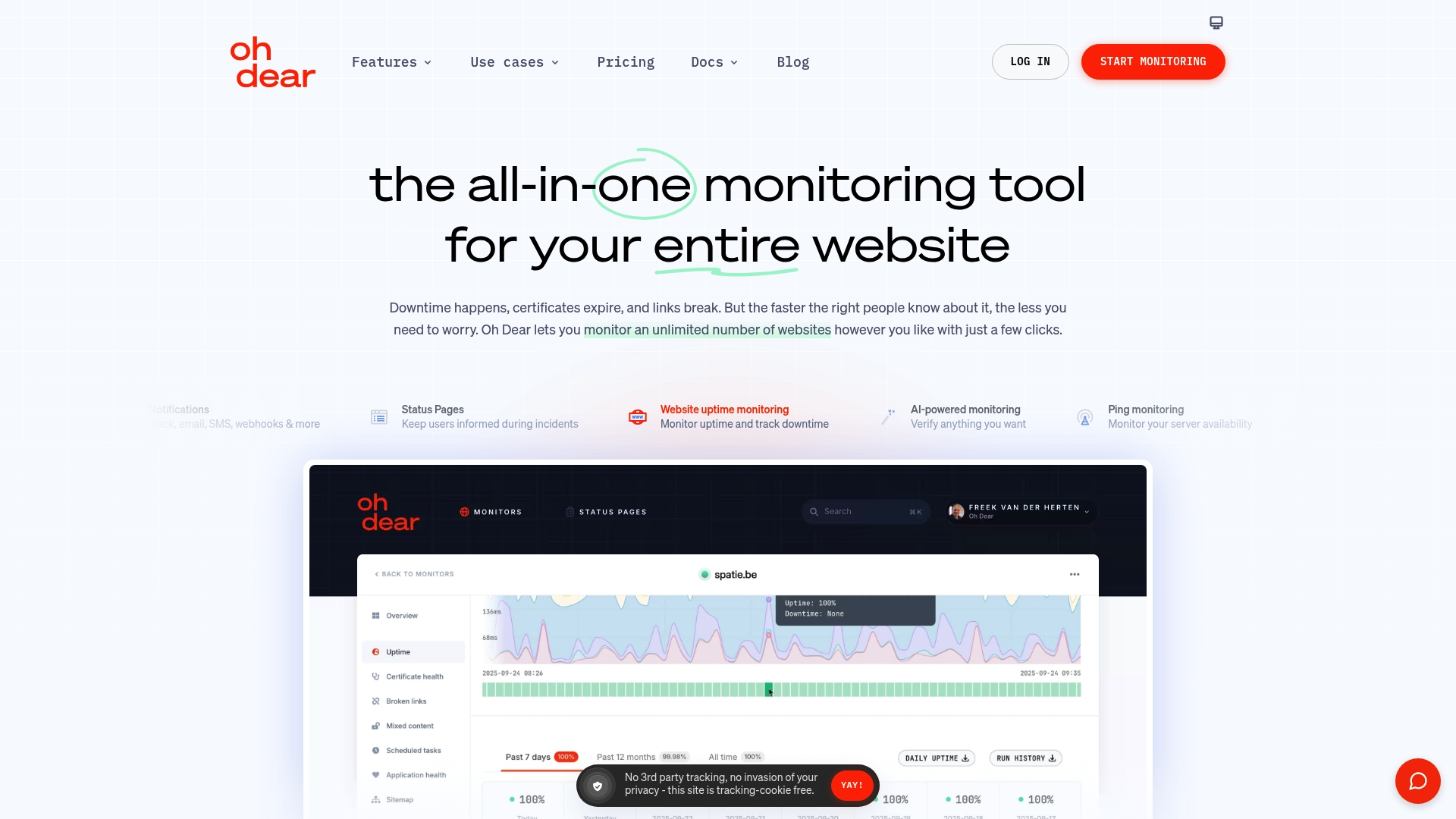
All plans include the same features with no feature lockouts across tiers. The platform also offers a 10-day free trial with no payment details required. As one of the contenders among best broken link checker alternatives 2026, Oh Dear combines uptime, link and SSL checks in one place.
Core Features
Oh Dear runs website uptime monitoring, API and endpoint checks, ping and TCP port tests, and application health probes for queues, storage and cache. It tracks SSL certificates, links, DNS changes and exposes public status pages for client transparency. The service sends alerts via email, SMS, Slack and webhooks so your team receives incidents where they already work.
Key Differentiator
That verified alerting from multiple regions and the absence of feature lockouts across plans set Oh Dear apart from simpler monitors. The vendor describes the verification as a measure to reduce false positives by confirming outages from several locations before notifying you. That model suits a team that needs reliable alerts and consistent features as it scales.
Pros
Oh Dear bundles a wide set of monitoring checks so you do not need separate tools for uptime, SSL and link validation. Verified alerts reduce chasing false positives and improve on-call efficiency. The platform supports public status pages and team management, which helps agencies report to clients without manual updates.
Cons
- Trust in third party reviews is often more informative than vendor claims, but the product site gives only limited third party details.
- Pricing may be higher than simpler alternatives for very small sites, although it becomes cost effective at scale.
- Information on integrations beyond standard notification channels is limited.
- No public details about advanced incident response workflows or on premise deployment options.
Who It's For
Agencies, development teams and hosting providers who manage multiple websites and must prove uptime to clients will get the most from Oh Dear. The platform fits teams that need monitoring beyond simple ping checks and that value verified alerts and client-facing status pages. Smaller single-site owners may find the pricing steeper than barebones monitors.
Real World Use Case
A digital marketing agency deploys Oh Dear across dozens of client domains. The team receives instant alerts for downtime, SSL expiry and broken links, publishes a public status page for each client, and exports automated reports for monthly meetings. That workflow reduces client queries and speeds up remediation.
Pricing
Plans start at €13/month for the mini plan, €22 for standard, €45 for plus and €73 for pro, with larger plans available for higher site counts. All plans include the full feature set and a 10-day free trial with no payment details required.
Website: https://ohdear.app
BrokenLinkCheck.com
At a Glance
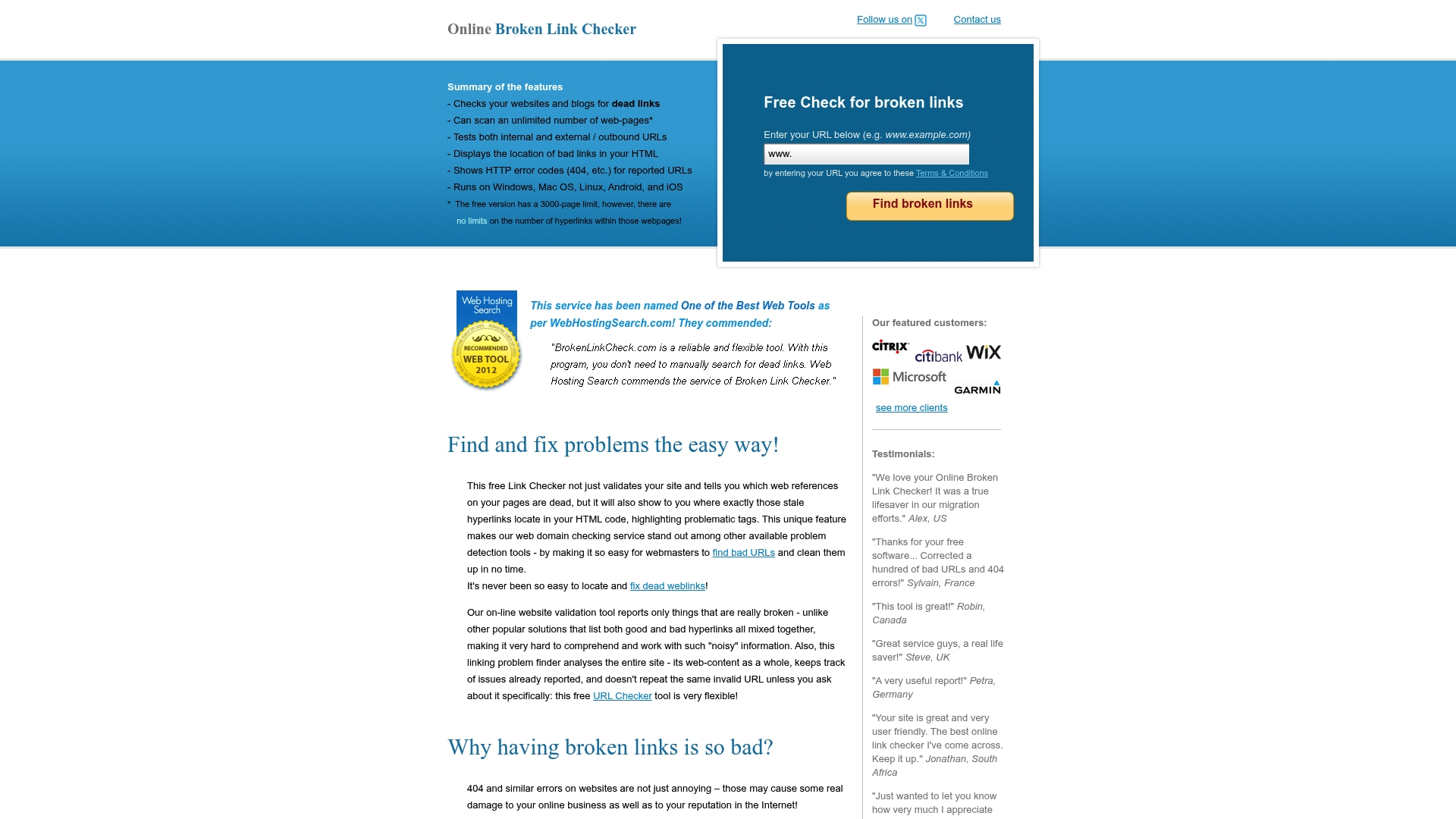
BrokenLinkCheck.com reports a free limit of 3,000 pages per scan. The tool highlights broken links inside the page HTML so you see the exact tag and surrounding code. It runs in any browser with no installation required.
Core Features
The checker scans internal and external URLs and reports HTTP status codes such as 404. It shows the location of each broken link inside the page HTML so you can jump straight to the offending anchor or image tag. The service works online across devices and offers a commercial option for higher limits and extra features.
Key Differentiator
The product uses HTML source-level highlighting to mark broken links directly where they appear in the markup. That lets developers and content editors locate the precise link tag, attribute, or surrounding text without guessing. The visible context speeds up manual fixes and reduces back-and-forth between the crawler and the code editor.
Pros
The tool is a free option with a generous reported page allowance that suits extensive audits within that limit. It flags both internal and outbound links and reports HTTP error codes, which helps you prioritise repairs by error type. It runs in a browser on any operating system and the vendor offers a commercial version for users who need higher limits and extra features.
Cons
- The free limit may be insufficient for very large websites. Larger sites will need the commercial product for full coverage.
- The tool reports broken links but does not fix them automatically. Repairs require manual edits or a separate workflow.
- External link checks depend on URL stability. If external destinations change, you must rerun the scan.
When It May Not Fit
If you manage a very large site that exceeds the reported free limit you will need the commercial plan. If your workflow requires automatic link repair or seamless CMS pushback, this tool will fall short. If you need continuous monitoring of many external domains without manual rechecks, consider a different system that offers scheduled rechecks and automated remediation.
Who It's For
Webmasters, SEO professionals, website owners, and digital marketers who run routine link audits will find this tool useful. It suits teams that can act on reports and perform manual fixes. It also fits agencies that audit multiple client sites and can run periodic scans within the reported limit.
Real World Use Case
A digital marketing agency runs this checker before every client site update. The team copies the highlighted HTML locations into their task tracker and assigns fixes to editors. That small change speeds up the QA cycle and reduces live-site 404s after deployments.
Pricing
The core service is free to use with the reported 3,000 page limit per scan. A commercial version is available on request for higher limits and additional features. Pricing details for the commercial product are provided by the vendor on enquiry.
Website: https://brokenlinkcheck.com
Comparison of Alternatives
Operaliq, Oh Dear, and BrokenLinkCheck.com each address unique aspects of link health monitoring and remediation. Depending on the specific requirements, one may suit better than the others. Below, we analyse the key trade-offs.
Integrated Recovery and Revenue Protection
Operaliq provides a distinct advantage by pairing broken link recovery mechanisms with insights derived from integrated revenue attribution systems. Users gain access to automated protections such as backup destinations and real-time alerts that orchestrate recovery for valuable links. Conversely, Oh Dear focuses on verified global alerting and public status page integration, appealing to agencies seeking multi-website transparency. BrokenLinkCheck.com's standout offering is its emphasis on direct HTML-level broken link annotations, making troubleshooting more efficient for developers.
Alert Efficiency and Verification
When prioritising reliable global incident alerting, Oh Dear has a competitive edge. Its feature for verifying outages across geographical checkpoints prevents false alarms, making it ideal for agencies managing multiple domains and requiring precise communication with stakeholders. Both Operaliq and BrokenLinkCheck.com lack this multiple-region verification, but their focus is more on link-specific insights and rapid recovery workflows.
Tailored Audit Processes
BrokenLinkCheck.com excels in simplified audit workflows by not requiring installation and offering context-sensitive link annotations directly in markup. Small SEO teams and webmasters conducting quick scans benefit from such usability, whereas Operaliq's integrated monitoring may present an unnecessary complexity for simpler audit needs. Oh Dear's suite suits organisations seeking unified monitoring but lacks the markup-focused detection offered by BrokenLinkCheck.com.
Best Fit
- Automated recovery for dynamic businesses aiming to secure revenue-bearing links against unforeseen failures leads to Operaliq.
- Agencies demanding reliable multi-region verification, public status pages, and client-ready reports should consider Oh Dear.
- Developers and audit teams requiring browser-based scanning and direct markup annotations will find BrokenLinkCheck.com.
Our Pick
Operaliq stands out due to its ability to tie link events to AI-driven revenue guidance, securing user attention through automated safeguards for valuable links. While Oh Dear wins on maintaining public domain status and trusted external visibility, Operaliq excels in internal operation optimisation. Businesses leveraging integrated revenue flows will benefit most.
Which platform delivers the most comprehensive link management and monitoring capabilities?
| Product | Core Feature | Key Differentiator | Best For | Pricing | Notable Limitation |
|---|---|---|---|---|---|
| Operaliq | Automated recovery and AI alerts | Integrated revenue connection | Creators and businesses with multiple revenue sources | Free tier, paid from £19/month | Best results need connected platform setup |
| Oh Dear | Website uptime and SSL checks | Verified multi-location outage alerts | Agencies managing multiple sites with client reporting needs | €13/month for the mini plan | Limited information on advanced workflows |
| BrokenLinkCheck.com | Free scanner highlighting HTML | HTML source-level broken link focus | Small websites and manual issue resolution | Free for up to 3,000 pages per scan | No automated link repair or continuous monitoring |
How to Tackle Broken Link Challenges with Operaliq
Broken links cause lost traffic and missed revenue. Creators, influencers, and online businesses linking multiple revenue sources need more than simple link checks. They require a solution that monitors link health continuously and recovers broken links automatically to protect income.
Operaliq offers Smart Links with backup destinations and Shield technology that reroute visitors instantly when redirects fail. It connects payment and social platforms, providing clear revenue attribution and AI-powered recommendations to improve campaign performance. See how Operaliq turns broken link issues into growth opportunities with real-time alerts and mobile monitoring.
Learn more about Operaliq and safeguard every link you share for better conversions and customer trust.
FAQ
What capabilities do Operaliq offer for monitoring broken links?
Operaliq provides continuous link health monitoring with real-time alerts and automated broken link detection. This feature allows users to spot failures before visitors encounter them, ensuring revenue is protected by redirecting links to backup destinations. Users can expect to maintain a seamless user experience and safeguard their revenue stream.
How does Oh Dear compare to Operaliq regarding monitoring capabilities?
Oh Dear excels with its verified alerts from multiple regions, ensuring accurate notification about outages. While Oh Dear provides detailed monitoring for uptime and SSL checks, Operaliq creates AI-powered recommendations and uses Shield technology to protect revenue-bearing links in real time. Operaliq is ideal for users who need comprehensive link intelligence alongside revenue attribution.
Which platform offers better integration with payment systems?
Operaliq connects directly with payment and commerce systems like Stripe and Shopify. This integration captures revenue attribution, enhancing your ability to monitor income directly linked to broken links and recovery actions. If you rely on diverse revenue sources, Operaliq offers a more streamlined experience.
Does BrokenLinkCheck.com provide automated link fixing?
BrokenLinkCheck.com does not fix broken links automatically, requiring manual edits for repairs. It flags broken links and provides their locations in the HTML, enabling users to make necessary adjustments. For those seeking automatic remediation, Operaliq is a more fitting choice.
What pricing tiers does Operaliq offer?
Operaliq has a free tier available for simple use, with paid plans starting at £19/month for Creator Pro and scaling up to £99/month for Business Pro. Users can choose a plan that best fits their monitoring needs and budget, making it accessible for a range of users.